
ExoGP
A sci-fi combat racing game with 6 degrees of freedom flight
The Project
ExoGP is a sci-fi combat racing game set on a distant planet with a hostile environment developed by Planet Atmos and Big Moxi Games. Instead of driving cars, players take the control of a pilot wearing a customizable flight suit called an Exo that enables them full freedom to fly through the three dimensional tracks. I was a game designer with Planet Atmos coming onto the project when ExoGP was still early in its conception. As one of only a couple designers on the project I was responsible for writing the majority of our design documentation and worked closely with Planet Atmos’ artist and the

team at Big Moxi to ensure clear communication. This was challenging at time as not only was Planet Atmos Team spread out across the US and Canada but Big Moxi's team had members in Brazil and Chile. An early access version of ExoGP was released in August 2024 on the Epic Store and was currently still playable last I checked. However, I was informed the project was cancelled in February 2026.
6 Degrees of Freedom Flight
What set ExoGP apart from other racing games was its mode of flight. There were only a handful of examples that used the vertical axis in the same way as us and none of them were racing games. In ExoGP, players were able to strafe and turn left and right as well as up and down or diagonally. Thruster acceleration, braking, rolling left and right, and a speed boost mechanic, called the Afterburner, rounded out the flight mechanics. Together they created a lot of choices for the player around how and when they used and combined these mechanics to leverage their emergent behaviors. Hammering out these mechanics was an early challenge that I worked with the Planet Atmos team (VP of Game Design Dylan Bushnell and Product Manager Joe Cammorata) to refine. Additionally, I created prototypes and diagrams to help communicate to the engineers at Big Moxi the importance of certain features of flight such as inertia and momentum, being able to perform a full 360° rotation in any direction, and the interactions of the different mechanics. As the mechanics were implemented I was also responsible for tuning the variables related to these actions and balancing how different Exo Suits would affect how players flew. There were also plans to expand flight by adding more mechanics like

reversing, drafting behind opponents, and sudden jukes. These would add new emergent behaviors but also allow us to extend ExoGP to game modes beyond racing, something that was always desired and we had to be cognizant of.
Combat
During the race the players could take damage. If their health got too low they would have to wait a few precious seconds before they could resume racing. Crashing was our first source of damage but not the only one. Throughout the race players would have access to Modules, weapons and gadgets they could use to fly faster, attack their opponents, or lay traps. I spent a good amount of time fleshing out Modules and their underlying systems, maintaining several documents that establish how they are earned, their shared properties and categories, and individual Module Designs. I wrote up a proposed set of 15 with 5 each dedicated to offense, defense (including traps), and movement. Designing these Modules and figuring out their interactions and how they change the dynamic between players in new ways was ultimately a really enjoyable experience that stretched my ability to concept different abilities in an action game while remaining connected to the same system. Ultimately, only a handful of these Modules were implemented, and I was also responsible for balancing them. New Modules became a constantly consideration as we assessed the state of the game and considered different game modes.
Tracks

I was the primary touch point with Big Moxi’s level designer, Matheus Oliveira. We worked closely to establish a vision and guidelines for our race tracks through regular meetings and I provided feedback on his work. Together we created about 20 tracks with, each with a reverse configuration, and there were challenges along the way. Our movement was significantly different from other racing games, including others that used flight, because of the amount of freedom our movement mechanics provided. There was a lot of discovery and iteration early on and to help I did a lot of research, both in games and out, such as roller coaster design, drone racing, and Formula 1 track regulations. To enforce the players to fly along the track I designed a checkpoint system and a soft barrier called the Bounds, that would allow players a brief window to go off track before they are reset to the track. This allowed players to experiment with small short cuts but not capable of skipping the large sections of the track. Before the project
ended we had plans to add dynamism to our Tracks through environmental hazards like wind and turbulence, lightning storms, and volumes that simulate the physics of flying through liquids or by magnetic surfaces Moving obstacles were also in the works and Pick Ups that would give players reasons to take less optimal paths to gain health, Modules, or fuel for the Afterburner.
The Exo
The player the suits wear was a key factor for the project that was a major initial selling point. Players would be able to collect different pieces of equipment and customize it with paint and decals. Further the Exo would have different stats based on the equipment that made it up. These stats would allow the player to fly faster, turn sharper, deal more damage with Modules, take more hits, and more. There were a lot of different considerations that I had to balance while figuring out all of the interactions of the different pieces that made up this configurable suit. Our art team wanted high customization but also to make extremely distinct pieces. There were concerns about overburdening the player with too many choices. As the plan was this to be a free live service game our plans for revenue also lied
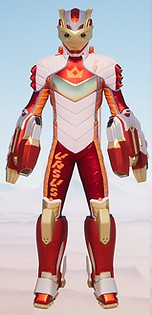


primarily in the assetization of these suits. Over the course of the priorities shifted leading to multiple iterations and I spent a lot of time communicating with the artists, both from Big Moxi and Planet Atmos, the engineers at Big Moxi, the rest of the design team at Planet Atmos, and even Kevin Beauregard, Planet Atmos’ CEO. Having to manage these different desires and seeing things from different people’s point of view to figure out why they prioritized different aspects of the system was, at times, exhausting. There were many iterations, at times we backpedalled or completely changed direction. Through all of that though I learned a lot about working with people and how to listen to them.
The Community

Since Season 0 went live we had a small but dedicated community. Our Community Team would hold weekly game nights in Discord and I really enjoyed getting to watch these players take what we had built into their hands. We updated it frequently and being able to interact with the community, gauge their reactions, and listen to what they wanted helped push our design. Some of our players got really good at the game, to the point that they were flying better than anyone on the team. We couldn’t always give them exactly what they asked for, sometimes what they wanted would make the game more difficult for new players or would cause conflicts with other
systems. Listening to what they were saying though I could try to find other solutions because I understood the underlying point of friction they were having. More than once they would suggest something that was already in the works which was also extremely validating. In either case I was grateful to them and by listening to them I was able to help make ExoGP better than it was before.
Want to Play
